



Connected Kitchens – Competitive Chains
Multi-site standardisation, limited space, part-time staff, energy efficiency: four structural challenges for the organised catering sector
by A. Anderloni - Ristorando
The combi-oven has long since ceased to be merely a piece of equipment. It has become infrastructure. Like a power station hidden behind a city’s walls, it is out of sight but determines everything: operational continuity, product quality, energy costs, and the ability to replicate a standard across a geographical area. When it works well, nobody notices it. When it stops, the whole kitchen grinds to a halt.
Over the last five years, the technical evolution of these systems has followed a precise trajectory, driven by three key factors: digitalisation, energy efficiency and reduced reliance on manual labour. The result is a machine that today resembles an intelligent industrial terminal more than a traditional cooking appliance. The cooking chamber is no longer a hot space: it is a controlled environment, almost a laboratory, where temperature, humidity, ventilation and actual load are measured in real time and regulated by algorithms. What was once entrusted to the chef’s experience is now managed by distributed sensors.
Whilst the hardware laid the foundations, it is the software that has transformed the way we work. Centralised recipe management allows multi-site chains to update menus and standards with a single click. Integrated HACCP traceability has transformed cooking logs from a bureaucratic formality into a governance tool. Continuous updates make the oven an evolving device, more akin to an industrial smartphone than a one-off household appliance. In symbolic terms, the oven has ceased to be a product: it has become a platform, a service that evolves over time.
Added to this is a less visible but equally profound transformation: connectivity. The oven no longer operates as an isolated unit, but communicates with the company’s information ecosystem. Integration with ERP systems, planning platforms and quality records ensures that data is generated in the kitchen and becomes an asset for management. At the same time, the concept of fleet management is gaining ground: a single interface allows users to monitor dozens or hundreds of ovens spread across multiple sites, distribute recipes simultaneously, compare performance between outlets and initiate preventive maintenance before a fault occurs.
For an independent operator, it is a sophisticated convenience. For a chain or a major player in the catering sector, it is a tool for industrial management: the same logic by which a company monitors a fleet of vehicles via telemetry, applied to the professional kitchen.
In this scenario, energy efficiency is no longer just an environmental issue. It is a direct economic factor: intelligent cycle management, automatic adaptation to workload, and reduced consumption during the less visible stages of the process. With large volumes, the difference between installed capacity and actual energy usage becomes a significant item in the balance sheet.
Lainox’s approach to chain restaurants
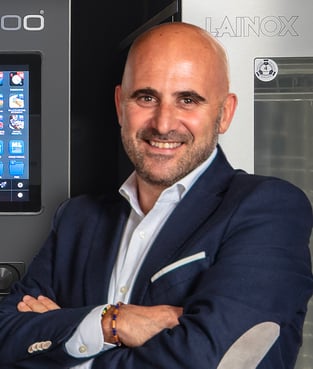 Marco Ferroni, Managing Director of Lainox Ali, begins with a premise that serves as a statement of positioning: talking solely about combination ovens today is a concept that belongs to the past.
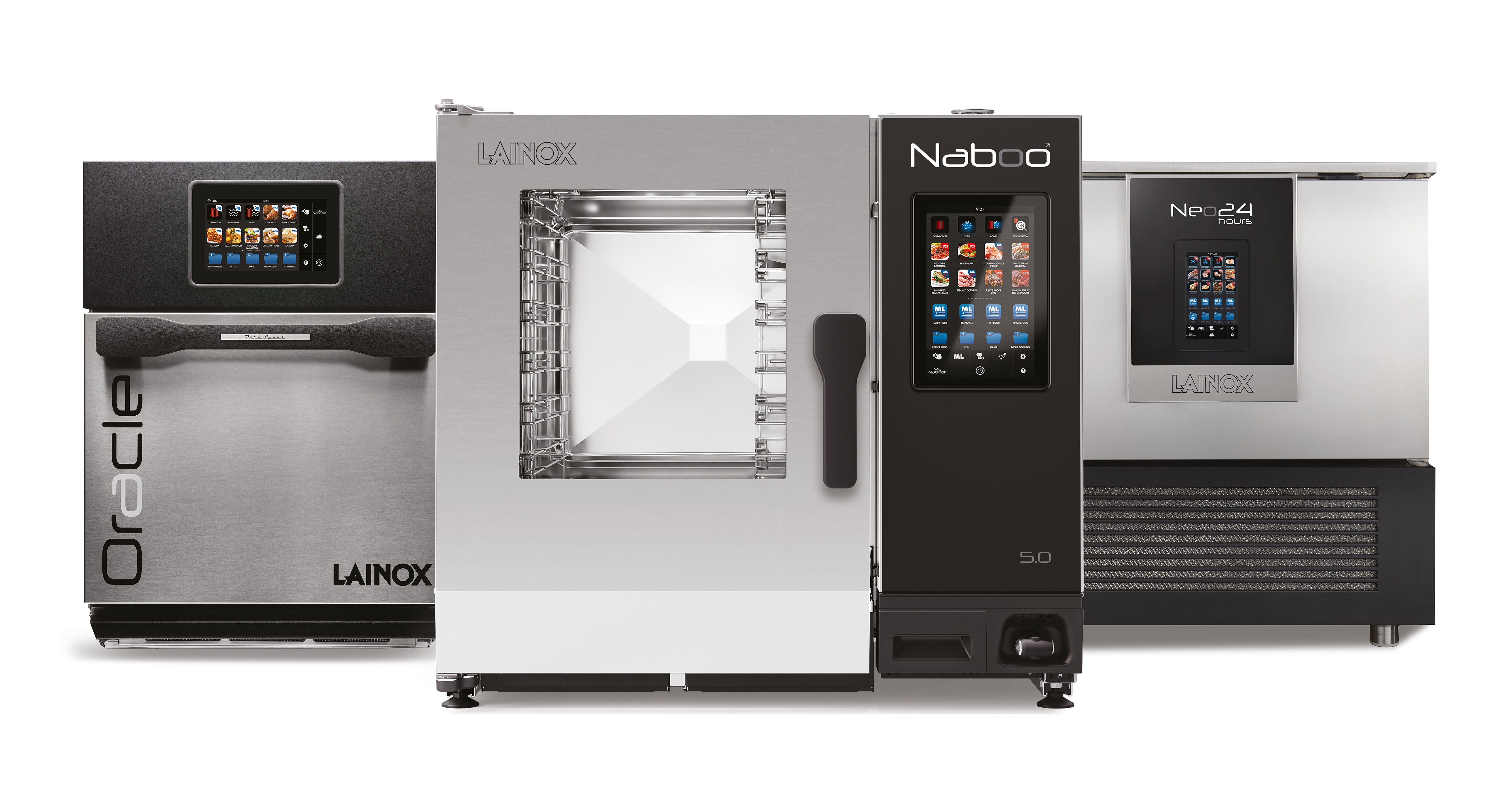
Chain restaurants have requirements that a single appliance struggles to meet, and Lainox has structured its range around three complementary products: Naboo for production and cook-and-serve; Oracle for accelerated cooking and rapid regeneration; Neo24hours, the combifreeze for cook-and-chill. An ecosystem that, on paper, covers the main operational scenarios, and which in practice requires chains to make a strategic positioning choice even before making a purchase.
When it comes to standardisation, Lainox operates on three levels: front-line staff, executive chefs and management. For front-line staff, the interface can be customised down to the bare essentials: each chain can display only the recipes currently in use, remove unnecessary functions and reduce perceived complexity. “If a chain cooks just one product, there will be a single icon on the display,” explains Ferroni – an extreme example that illustrates the logic, but which in practice applies only to the most standardised contexts. For the executive chef, the Nabook cloud allows remote updates to the entire network or to groups of ovens. For management, the same data – cooking cycles, washing cycles, energy, water and detergent consumption – become operational control tools. A client with over 5,000 connected ovens would have achieved savings of over one million euros a year: a significant figure, which nevertheless depends on scale, context and a level of integration that is difficult to generalise.
When it comes to compactness, Lainox delivers concrete results. The Compact version presented at Host Milano 2025 measures 51 centimetres in width and maintains the performance of a latest-generation oven. The floor-standing models with two independent chambers allow for simultaneous operation in different modes – steam and grill, for example – accommodating up to 16 GN 1/1 trays within the same footprint. Verifiable figures that meet a real market need.
The staffing issue is addressed through what Ferroni describes as a hybrid approach: combining human and technological support, rather than replacing one with the other. On the human side, bespoke training upon installation, local Naboo Experience events and the Pronto Chef service, available 365 days a year, form a support network that goes beyond simple after-sales service. On the technological front, Naboo Coach supports the operator with tips on cooking, washing and maintenance, whilst the QR codes on each machine link to video tutorials when needed. A system that aims to reduce reliance on individual experience, but which – like any digital tool – works all the better the more it is integrated into the organisation’s operational culture.
When it comes to energy management, the Smart Energy System adjusts power output according to the load and automatically reduces the temperature when the oven is running empty. The Energy Monitor displays consumption in real time, either for individual machines or for the entire fleet. “On request, the data can be integrated into the customer’s management systems,” explains Ferroni – a feature already adopted by some chains, which transforms the oven into an active component of the operational control network. Lainox ovens are Energy Star and ETL certified: certifications that provide an objective benchmark in a field where promises of savings multiply faster than verified data.
Looking ahead of the rest
The combi-oven, therefore, is no longer what it was twenty years ago. It has changed in terms of technology, in the role it plays within the organisation, and in the language its manufacturers use to describe it. It has become a system, a platform, an asset that can be managed remotely. And professional kitchens, as a result, have ceased to be a separate entity from the rest of the business: they have become part of the network, the data, and the decision-making process. Understanding these transformations before they become obvious is exactly what Ristorando has always sought to do – with the same attention with which the best operators in the sector scrutinise their figures: without oversimplification, without facile enthusiasm, and with the awareness that in professional foodservice, the difference between those who grow and those who stand still is often measured in millimetres of foresight.


